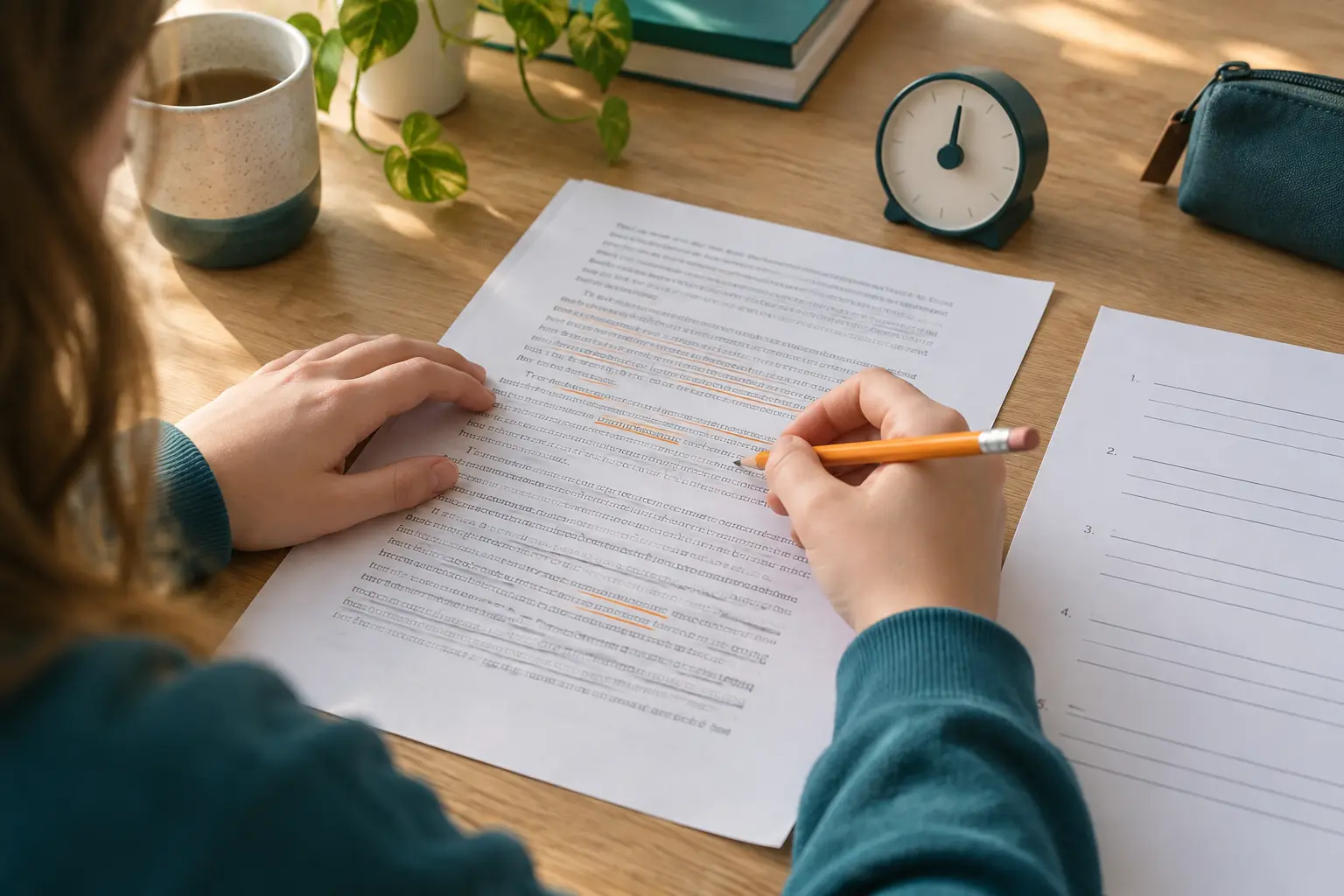
Does your child read slowly? Build fluency and understanding.
A personalised paper-based reading WeekBook with targeted exercises, a 45-minute daily routine and a progress log for pace, accuracy and comprehension.
Does your child take a long time to read a page, return to the same lines or struggle to explain what they have read? Slow reading can make homework demanding even when a student spends a lot of time studying. For students aged 11–18, MyWeekbook starts with a practical question: which activities can help this student read more fluently and understand the text?
RESEARCH REFERENCES
How many words per minute?
MyWeekbook synthesis of multiple sources: Hasbrouck & Tindal (2006, 2017), Spichtig and colleagues (2016), and Brysbaert (2019). A starting point, not a judgement: language, passage difficulty and comprehension affect results. These are not worldwide averages or Italian norms.
References by approximate age. English data from separate studies: median for student oral reading and mean for silent reading. Results are presented side by side, without calculating a new average across studies.
Approximate age
Aloud: correct words/min
Silently: words/min
Sources
7–8 years
100
≈ 116
H17 + S16
9–10 years
133
≈ 148
H17 + S16
11–12 years
146
≈ 164
H17 + S16
13–14 years
151
≈ 170
H06 + S16
15–16 years
160
≈ 187
S16
17–18 years
171
≈ 188
S16
Adults
183 words/min*
238 non-fiction; 260 fiction
B19
H17/H06: Hasbrouck & Tindal, end-of-school-year medians (2017/2006). S16: Spichtig et al. (2016), data collected in 2011, original-passage means from table 3, rounded to whole numbers; results required at least 70% comprehension. B19: Brysbaert (2019), adult means. Ages are our approximate mapping from sample school years, not directly age-normed bands.
School studies concern US samples and English texts. These are orientation points from international research, not a universal developmental curve. A median is not an arithmetic mean or a diagnostic threshold. *Adult oral reading measures words/min rather than correct words/min and is not directly equivalent to the school measure. Italian reading requires language- and school-year-specific references.
Choose an unseen, age-appropriate passage in the language you want to observe. Use different passages for oral and silent reading.
Read for 60 seconds with a stopwatch. Mark the last word and count words reached. For oral reading, an adult records incorrect or skipped words.
Close the text and explain its main idea and two details. If you cannot, speed alone does not indicate effective reading.
Repeat with two comparable new passages; record language, difficulty, errors and comprehension. Do not compare a rereading with a first reading.
Calculate words per minute
Formula: (words − errors) × 60 ÷ seconds. For silent reading, no errors are subtracted: check comprehension separately. The calculation stays in your browser and saves no data.
This is an informal observation, not a standardised or diagnostic test. Comparison with norms requires matching materials and procedures.
Tell us the school year, reading language and difficulties you have noticed, and upload a comprehension assignment, a marked test or the syllabus. A tutor reviews the material and validates the personalised WeekBook. Print the PDF: it contains level-appropriate passages, progressive exercises, comprehension questions, self-correction guidance and a progress log. The first WeekBook is free, with no card required.
TWO SKILLS TO PRACTISE TOGETHER
Read more fluently. Understand what you read.
Targeted practice for more fluent reading
Activities may include purposeful rereading of short passages, reading aloud with attention to punctuation and phrase groups, and exploring vocabulary in context. Activities are selected around the difficulties identified. The aim is a more natural, accurate pace: skipping words or losing meaning is not progress. For some initial activities, an adult can help by listening and recording errors.
Understand, remember and explain the text
Questions address explicit information and connections that must be inferred. Students identify the main idea of a paragraph, write a short summary in their own words and return to the passage to check their answers. Self-correction helps them see what was misunderstood and which part of the text clarified the meaning.
THE WISE METHOD
45 minutes a day. Paper and pen.
The WISE routine includes 20 minutes of work, a 5-minute break and another 20 minutes of work. The final 5 minutes are for self-correction and reflection. Reading, exercises and the progress log stay on paper; an adult can measure time using a watch or stopwatch. The student does not need an app, and not every exercise is timed.
20MIN
Reading and practice
5MIN
Break
20MIN
Practice and self-correction
The final 5 minutes are for self-correction.
THE PROGRESS LOG
Notice progress. One day at a time.
THE COMPARISON
A starting measure and a comparable final check
The first measure uses an unseen passage. Log activities, difficulties and answers daily; take brief timed measures at the points specified in the WeekBook. At the end, use a new passage of similar language, length and difficulty. Rereading is useful practice, but a faster time on the same familiar passage does not establish general improvement. Keep silent and oral reading records separate.
THE NEXT GOAL
Seven days to start observing progress
The log shows patterns over time and helps identify the next learning goal. Read faster times alongside comprehension and accuracy, considering tiredness and text difficulty. We do not set a universal target reading speed or promise percentage gains. One week starts the process; building lasting skills may take longer.
What the WeekBook tracks
The log records date, passage, language, reading mode and results. It is an educational tool for observing individual progress, not a standardised assessment.
Pace, accuracy, comprehension and independence
Measure
How to record it
How to interpret it
Reading pace
Passage word count × 60 ÷ seconds taken.
Compare passages of similar difficulty in the same language and reading mode.
Oral reading accuracy
Record skipped or misread words using consistent criteria.
Correct words per minute = (words read − errors) × 60 ÷ seconds. An adult listens; this measure does not apply to silent reading.
Comprehension
Correct answers out of the questions asked, plus a short summary.
Use questions of comparable difficulty and the same rules on looking back at the passage.
Independence and effort
Note help needed, difficulties observed and perceived tiredness.
Consider these alongside results, without using them to label the student.
Educational reference: the IES/What Works Clearinghouse guide for grades 4–9 recommends purposeful fluency work and comprehension practices, including questions, summarising and checking understanding. These principles inform the activities; they do not validate MyWeekbook or its seven-day format. Read the IES guide.
YOUR FIRST WEEKBOOK IS FREE
How to start and continue
In your family area, enter “Reading and comprehension” as the subject, specify Italian or English and describe the difficulties. Upload at least one readable school document: an assignment, marked test or syllabus. Daily monitoring uses the printed WeekBook log; it is not an automatic online measurement. After the first WeekBook, optional WISE Progress includes a review, progress report, 30-minute live feedback and another personalised WeekBook as an optional next step after the trial.