Weekly goals
One observable goal gives the week a precise direction. The aim is a small change that can be checked, not a vague promise to ‘study more’.
The WISE Method turns the student’s real school evidence into a seven-day WeekBook. Each week isolates one difficulty, addresses it with personal exercises and measures what changed.
One observable goal gives the week a precise direction. The aim is a small change that can be checked, not a vague promise to ‘study more’.
Activities are built from the student’s real curriculum, marked work, recurring errors and the family’s observations.
During study, phones, tablets and computers stay out of reach. The student works with paper, pen and their own reasoning.
Each day divides the work into two short blocks separated by a break. The final five minutes are dedicated to self-correction.
A short explanation and an initial guided exercise.
Step away from the page before restarting.
Independent practice. The final 5 minutes are for self-correction.
Paper and pen ready. Devices away. One goal at a time.
We read marked tests, assignments, syllabus and errors without starting from a label.
We choose one specific difficulty to work on during the week.
We build progressive paper-based exercises with clear instructions.
We compare the same indicator before and after the week.
It does not return a generic label. It connects observed evidence to a weekly goal and a concrete criterion for checking change.
Mistakes, correct answers and incomplete steps.
Secure skills and two precise gaps.
One observable result in seven days.
Comparable questions before and after.
A tutor checks the evidence, defines the observable goal and reviews every WeekBook before delivery. The service supports study organisation and does not replace school, specialist teaching or clinical assessment.
The WISE Method organises study around a weekly goal, personalised exercises and paper-based learning. It is designed for secondary school students facing a specific difficulty: a disappointing test, an unclear procedure or a topic that keeps causing errors. It starts with actual schoolwork so the pathway remains connected to classroom expectations.
The WeekBook provides materials for the pathway. The method guides the choice of focus, the distribution of activities and the final check. A week is a focused learning cycle; some difficulties require several cycles and discussion with the teacher. The service supports studying alongside school.
“Study more” does not tell you what to do. A useful goal describes a skill: solving a percentage problem, explaining a scientific process or identifying a text’s main idea. Connect it to an initial attempt and a question that can check understanding at the end. Choose a realistic scope for the available materials and time.
One example is “choose a method for reverse percentages and explain the steps”. If basic percentages are uncertain, focus on that prerequisite first. The initial check guides the work rather than labelling the student. After the week, the next step depends on the answers and remaining errors.
An incorrect answer may reflect an unclear concept, a poor choice of method, execution or misunderstanding the instructions. A complete marked test, teacher feedback and curriculum information help distinguish these issues. An isolated answer without its question may conceal the real difficulty. Readable materials support relevant activities.
Work can move from a short explanation to a guided example, an independent attempt and correction. Adapt the progression to prior knowledge. Personalisation means selecting the content and support required for a precise goal and checking that exercises practise the intended reasoning.
The online service is used to submit materials and receive the PDF. During activities, use the printed WeekBook with paper and pen. Prepare pages, tools and a workspace beforehand to reduce interruptions caused by missing materials. Keep devices away during the session.
Paper makes attempts, steps and corrections visible, helping the student and anyone supporting them discuss a specific error. Screen-free work is an organisational choice for this pathway rather than a claim that paper is always superior. Adapt tools and support to the student’s needs and school guidance.
The week distributes opportunities for understanding, practice and checking. One pathway begins with a short attempt, revisits the required concept, introduces guided exercises and moves to independent problems. Later sessions revisit errors and include a new question. There is no need to repeat the same worksheet every day.
Fit activities around school assignments and fixed commitments. If a session is missed, review priorities and use a flexible slot instead of automatically doubling the next day’s work. Keep the schedule sustainable: a seven-day cycle is not the total study requirement for every subject.
In the first block, review a focused explanation and attempt guided practice. After a five-minute break, move to independent practice or a closed-notes question. In the final five minutes of the second block, check the attempt, record the reason for an error and choose what to revisit. The 45 minutes include the break.
The duration is a suggested routine for a focused goal and can be adapted. Time alone does not measure study quality. A complete attempt and an understood correction are more informative than minutes spent on a page. If the concept remains unclear, seek clarification before accumulating similar exercises.
Compare attempts requiring the same skill, but change the question or data to avoid measuring memory of a solution alone. Observe method selection, accuracy and the amount of help required. Ask for an explanation too: a correct result may hide an uncertain step.
At the end, record what the student can do independently, what needs a prompt and what remains unclear. Use this information to choose the next goal or discuss it with the teacher. Progress on one specific skill does not guarantee a grade or imply that every learning gap has been resolved.
An adult can help prepare materials, agree on a time and interpret instructions. During an attempt, allow the student time to reason before suggesting an answer. Make help specific: ask which step they have completed and which information is missing.
For a tutor, completed pages support discussion by showing procedures and corrections alongside results. For a parent, a brief agreed check provides more information than simply asking whether studying happened. Where specialist support is needed, coordinate with the school and relevant professionals.
Prepare complete test or study materials, including questions, attempts and teacher comments. Add relevant curriculum information and identify the difficulty you want to address. Check that every page is readable. Consult the service’s supported formats and upload limits during the request.
When you receive the PDF, read the goal and instructions before starting. Organise the week, keep your attempts and use self-correction to identify questions for your teacher or tutor. Downloadable samples show the material’s structure; the personalised pathway starts from the evidence submitted.
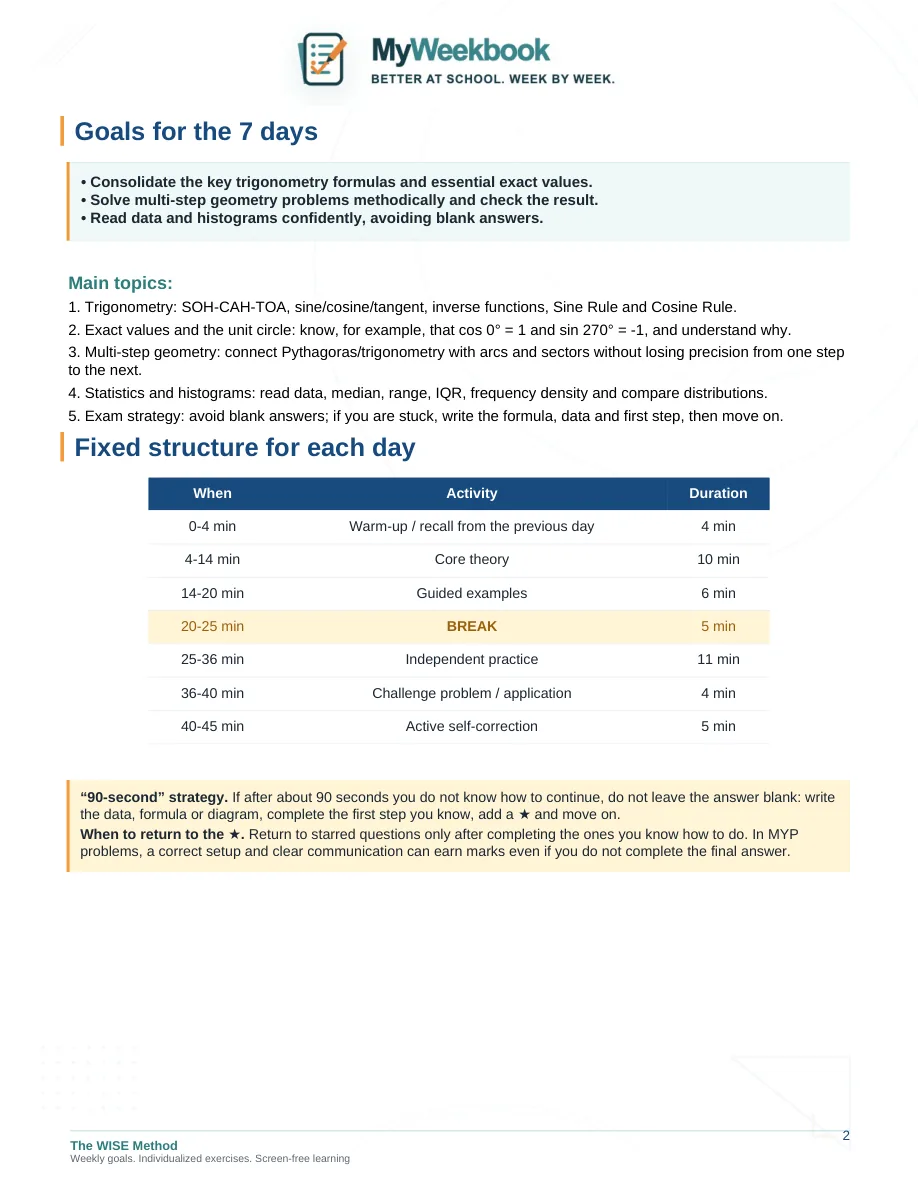
Browse the maths sample: goals, routine and exercises in a demonstration PDF.
Open the sample PDFIt organises a focused cycle around a difficulty alongside lessons, homework and school preparation.
This page describes three pillars: Weekly goals, Individualized exercises and Screen-free learning. WISE is the name of the MyWeekbook method.
Yes: 20 minutes of work, a five-minute break and 20 minutes of work. The last five minutes of the second block are for self-correction.
The week addresses a focused goal. Broader difficulties may require more cycles and teacher support.
The online service handles requesting and downloading materials. Pathway activities use the printed WeekBook.
Compare different questions requiring the same skill and observe accuracy, explanation and independence.
No. Outcomes depend on starting difficulties, work completed and school demands. Evidence on learning techniques does not itself validate the product.
Yes. Italian and English sample PDFs illustrate goals, routines and exercises.
No card required. What comes next is always the family’s choice.
Create your first MyWeekbook — Free →