Understand before memorising
Before repeating a page, identify what you need to learn: facts, definitions, relationships or procedures. Check the teacher’s instructions and choose a small set of concepts. Ask what each means, why it matters and which example makes it concrete. Clarify unfamiliar terms using the textbook or your teacher.
Remembering a formula is insufficient if you cannot choose when to use it. Describe a situation where it applies and one where it does not. For a definition, add an example and a non-example. These checks reveal whether the content means something to you or you are simply reproducing words.
Why recognising a page is different from recalling it
When rereading, headings and sentences provide cues. Everything may feel familiar even when you cannot reconstruct the explanation without the text. Close the book and write three main ideas, then compare them with the source. Which points were missing, inaccurate or disconnected?
Rereading can help you understand or correct a point. Place it between attempts rather than using it as your only check. Highlighting can help you navigate a text, but colour on a page does not show that you can answer a question. Check the required skill: explaining, comparing, applying or solving.
Active recall: attempt an answer before looking
Active recall means retrieving information without having the answer in front of you. After initial study, close the materials and answer a question, reconstruct a process or solve an exercise. Compare your attempt with a reliable source afterwards. Feedback keeps mistakes from remaining uncorrected.
Start with focused prompts: “What are the stages of this process?” or “Why is this choice appropriate?”. If you recall nothing, narrow the question or revisit a prerequisite. These attempts are learning opportunities rather than graded tests. Keep partial answers too: they show where to restart.
Correct your attempt and try a different question
After an attempt, distinguish missing information, a confused concept and incorrect application. Record the correction and its reason: “I reversed cause and effect” is more useful than “wrong”. Revisit the explanation you need, then close the materials again and produce a complete answer.
A freshly copied answer can feel learned. Check it later with a new question or example. For proportions, change the data and explain your method. For a historical event, use a comparison question instead of repeating the same sentence-completion prompt.
Spaced practice: when to revisit the material
Spread retrieval opportunities across different days rather than concentrating all repetition into one evening. For example, study on Monday, attempt recall on Wednesday and check again at the weekend. Adapt the intervals to the deadline, difficulty and what you actually remember.
There is no fixed calendar that works for every topic. If an answer is uncertain, revisit it sooner and clarify the issue. If you can explain and apply the content, leave more time before the next check. Keep some questions on previous material as you introduce new topics.
How to use flashcards beyond flipping them
A useful flashcard asks a clear question with a checkable answer. Respond aloud or in writing before turning it over. Judge your attempt honestly: recognising a word after reading it is different from retrieving an answer. Split cards containing an entire chapter into smaller prompts.
Combine fact and definition cards with explanation prompts. For vocabulary, produce a new sentence; for a formula, explain when it applies. Cards should sit alongside full problems, texts and extended answers. Remove ambiguity and verify answers against school materials.
Explanations, examples and maps: build connections
Connect new content to what you already know and explain the relationship. A personal example can help if it is accurate and relevant. Ask how two concepts are similar and which difference changes the answer. Check invented or vague connections before learning them.
A concept map can organise ideas and relationships. After building it, put it aside and reconstruct the links or explain one branch, then compare with the source. This makes the map part of an active study process. Its usefulness depends on how you use it, beyond producing a tidy page.
Examples of recall practice by subject
Match the prompt to the knowledge required. In history, connect events, causes and consequences; in science, reconstruct a process and explain its stages; in maths, choose and apply a procedure. Adapt the examples below to your curriculum and teacher’s expectations.
When precise terminology is required, keep the correct terms and add your own explanation. When reasoning is required, check the steps as well as the final answer. For reading, recall evidence from the text: a plausible account may still be inaccurate if it does not match the source.
| Subject | Closed-notes attempt | Check |
|---|---|---|
| History | Explain causes and consequences of an event | Check relationships and chronology against the text |
| Science | Reconstruct stages of a process | Check sequence, terminology and explanations |
| Maths | Choose a formula and solve a new problem | Check conditions, steps and result |
| Languages | Use new words in a sentence | Check meaning and form |
| Literature | Explain a theme with textual evidence | Check interpretation and reference |
A seven-day revision example
Choose a focused goal and collect questions with checkable answers. The example below combines initial study, recall and application. Fit it around homework: it does not require daily work on the same subject or neglecting other commitments.
If an attempt reveals a difficulty, adjust the next session. A conceptual gap needs explanation; forgotten information may need further retrieval; incorrect application needs comparison between cases. The calendar is a guide to update rather than a sequence to finish regardless of the evidence.
| Day | Activity | What to observe |
|---|---|---|
| 1 | Understand a topic and prepare prompts | Uncertain terms and prerequisites |
| 2 | First recall attempt and feedback | Missing or confused information |
| 3 | Homework and other topics | Space in the schedule |
| 4 | Recall with different examples | Explanation and application |
| 5 | Correct the priority issue | Reason for the error |
| 6 | Brief check or flexible slot | Independence compared with the first attempt |
| 7 | New question and next plan | What to keep reviewing |
A practical session: prompt, attempt, check
Prepare materials and choose a few questions. Work from content you have studied, attempt answers without notes and check using the textbook or feedback. Record one priority error and use the next block to address it. A break helps structure the session; adapt its length to the student and workload.
One option is twenty minutes of work, five minutes of break and another twenty minutes of work, with the final five reserved for self-correction. The forty-five minutes include the break. On busy days, choose a brief, focused check rather than rushing through everything. Schedule a return to the uncertain point.
Common mistakes and how to check retention
Avoid looking at answers immediately, using identical prompts every time or practising only what already feels easy. Use a small mixed selection and check your attempts. If you recall information only in textbook order, start from a different prompt. If you learn a sentence by heart, check that you can explain its meaning.
Check progress after an interval and with a new question. Look for accuracy, explanation and independence as well as speed. A blank during one attempt does not describe all your abilities: identify the step to revisit. If difficulties repeatedly block your work, ask a teacher or tutor to help adapt materials and support.
Use recall and self-correction with your WeekBook
A WeekBook can organise tasks around a specific difficulty. After an explanation or example, attempt independent practice and use correction to identify what is missing. Add a later check to your weekly plan using a new question. You do not need to add another full pathway on top of every assignment.
The maths sample below shows goals, practice and self-correction. It is a demonstration: adapt your own content and timings to real needs. Research on study techniques does not validate the product itself or guarantee an individual academic outcome.
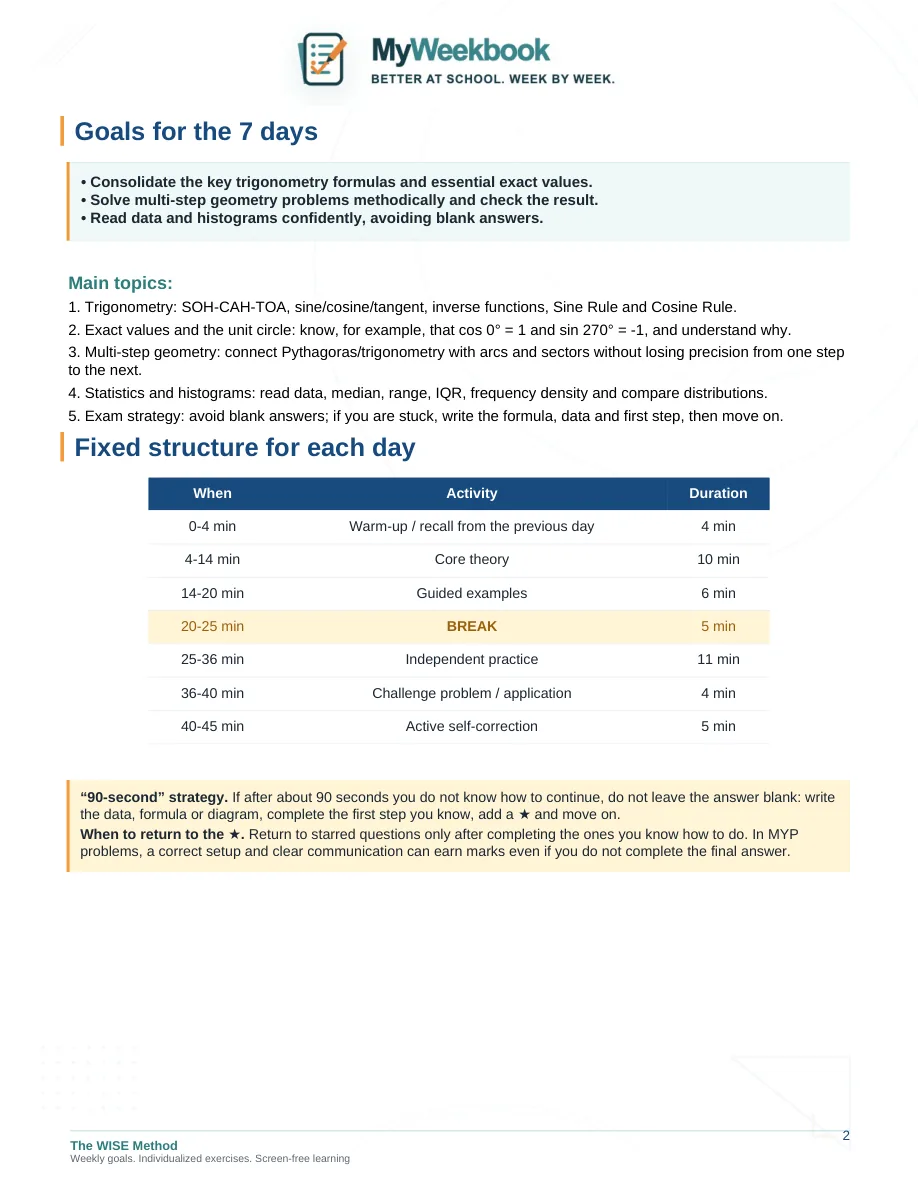
See a sample WeekBook
Explore a seven-day maths example and see how goals, exercises and self-correction fit into a routine.
Open the sample PDFResearch on learning techniques
These sources discuss retrieval and distributed learning. The activities and calendar here are practical examples rather than validated protocols.
- Dunlosky et al. (2013)
Review of evidence on practice testing and distributed practice.
- Institute of Education Sciences (2007)
Guidance on organising learning and checking understanding.
- Karpicke & Blunt (2011)
Research on retrieval practice; it does not test the calendar proposed here.
Questions about remembering what you study
How can I remember without rote learning?
Understand the content, recall it without notes and check it. Add examples and application questions while keeping precise terms when required.
What is active recall?
It means attempting to retrieve studied content without seeing the answer, followed by checking and correction.
How often should I revise?
Spread attempts across days and adapt intervals to difficulty, deadlines and results. There is no universal sequence of days.
Are flashcards enough for a test?
They can support focused questions, but combine them with problems, explanations and tasks similar to the assessment.
Can I use concept maps?
Yes. After organising concepts, reconstruct or explain the links without looking, then compare with the source.
Why do I forget after rereading?
Familiarity with the text may exceed what you can retrieve independently. A closed-notes attempt shows which points need more work.
How can I remember formulas and definitions?
Combine recall with an explanation and an example. For formulas, also check conditions of use and application.
What if I cannot remember anything?
Narrow the prompt, revisit the explanation and try again. If the difficulty continues, ask for clarification of the concept or prerequisites.
How can I check longer-term retention?
Try again after an interval, without notes and with new questions. Check accuracy, understanding and the ability to apply what you recall.