Why are you putting schoolwork off? Find the first obstacle
Before adding study hours, notice where you stop. Is it hard to choose a task, understand the instructions or risk making a mistake? Do you check your phone before opening the book? Similar delays can need different kinds of support.
Describe a concrete episode: “Yesterday I needed to start my essay, but did not know how to make an outline.” This gives you something to work on rather than a judgement about your character. Choose one adjustment for the next session: clarify the task, shrink the first step or prepare materials.
Choose a small goal that actually helps
“Study science” is too broad to tell you where to start. Turn it into an action: “read the question, identify three terms and explain the first one”. Your first step should contribute to the actual assignment. Reorganising the whole desk can keep you busy without moving the work forward.
Define what completing the step looks like: one question rewritten, one piece of information identified or three outline ideas. You can continue afterwards without deciding immediately how to finish everything. If the step is still too hard, divide it further or ask which prerequisite you need.
How to begin: a five-minute attempt
Prepare your book, paper and pen, then choose one action. You can use five minutes as a starting window: write what the question asks, attempt the first step or sketch an answer. This is not a magic duration or a guarantee that work becomes easy; it makes the attempt bounded.
At the end, check what happened. If you can continue, choose the next block. If you are stuck, record the precise question and seek an explanation. If you must stop, leave the next action written down. A brief attempt should leave a useful trace rather than become a way to avoid the remaining work.
Decide when and where you will start
Replace “I will study later” with a concrete appointment: “after my snack, at 5 pm, I will open my notebook at the table and attempt the first exercise”. Fit the time around school, travel, sports and rest. An unrealistic appointment does not help.
Prepare the first page before the appointment. If you use a reminder, name the action instead of giving yourself a vague instruction. You need a time, a place, materials and an action, not a complicated system. After a few attempts, review whether the timing is practical.
Reduce distractions before you begin
If your phone interrupts work, decide where to leave it and when to check it. Close unnecessary tabs and notifications. When an assignment needs a device, prepare relevant resources and limit other access for the agreed period. For paper-based tasks, keep only the materials you need nearby.
When another task comes to mind, note it on a “later” sheet and return to the current step. In a shared space, agree on a quieter window or choose work that fits the setting. The goal is to make staying on task easier rather than demand perfect conditions.
Practical examples: from an avoided task to a first action
The first step depends on the subject and the obstacle. You do not always need the easiest part; choose an accessible action that unlocks the required work. If the instructions are unclear, clarify them before trying to finish the exercises.
Check your first attempt against the book, notes or teacher feedback. If a formula or term remains uncertain, write a specific question. The examples below are starting points to adapt to your curriculum.
| Avoided assignment | First step | Evidence to keep |
|---|---|---|
| Maths problem | Identify the data and question | Data noted and first step |
| Essay | Write three ideas and choose an order | Initial outline |
| Science chapter | Choose one process and a question | First explanation attempt |
| Vocabulary | Use two words in a sentence | Checked sentence |
| History assessment | Answer one question without notes | Answer and question to clarify |
From getting started to a sustainable session
Once you have begun, choose a work block with a goal and an ending. One option is the MyWeekbook routine: twenty minutes of work, a five-minute break and another twenty minutes of work. The last five minutes of the second block are for self-correction, so the forty-five minutes include the break.
You do not have to move immediately from no studying to a complete session. Adapt the block to the task and your ability to work on it. Decide what you will do after the break before taking it. Check an answer or a step at the end: elapsed time alone does not show understanding.
A week of making it easier to restart
Try one small adjustment at a time. Over seven days, notice what blocks the start, prepare a first step and record the outcome. The plan below is an organisational experiment rather than a promise to eliminate procrastination in a week.
If you miss a day, restart in the next available slot with a smaller action. Avoid automatically doubling your work to repair a streak. Consistency includes knowing how to resume. At the end, keep helpful changes and revise those that did not work.
| Day | Small action | Check |
|---|---|---|
| 1 | Observe a delayed task | Name the first obstacle |
| 2 | Break down an assignment | Choose a bounded step |
| 3 | Prepare materials beforehand | Try the agreed start |
| 4 | Remove one distraction | Record interruptions |
| 5 | Write down the next action | Restart from that note |
| 6 | Use a flexible slot | Adjust postponed work |
| 7 | Review the week | Keep one useful change |
Parents and tutors: support without doing the assignment
Ask which step is getting in the way and agree on an initial attempt. An adult can clarify instructions or prepare materials while leaving the response to the student. A short agreed check-in is more concrete than repeated reminders to study.
If delays continue to prevent assignments and school participation despite adjustments, discuss the difficulty with the teacher and those supporting the student. This guide concerns study organisation; it does not identify clinical causes or replace professional assessment when needed.
A WeekBook to make the first task clear
When the obstacle is not knowing what to practise, a focused pathway can clarify the work. Start with school materials and a specific difficulty. Schedule WeekBook activities alongside homework and prepare the first exercise before the session.
A WeekBook does not by itself remove the reasons for delay or guarantee school outcomes. It is supporting material: explanations, attempts and self-correction can make the next step visible. Browse the sample PDF to understand the structure and follow school guidance when adapting the plan.
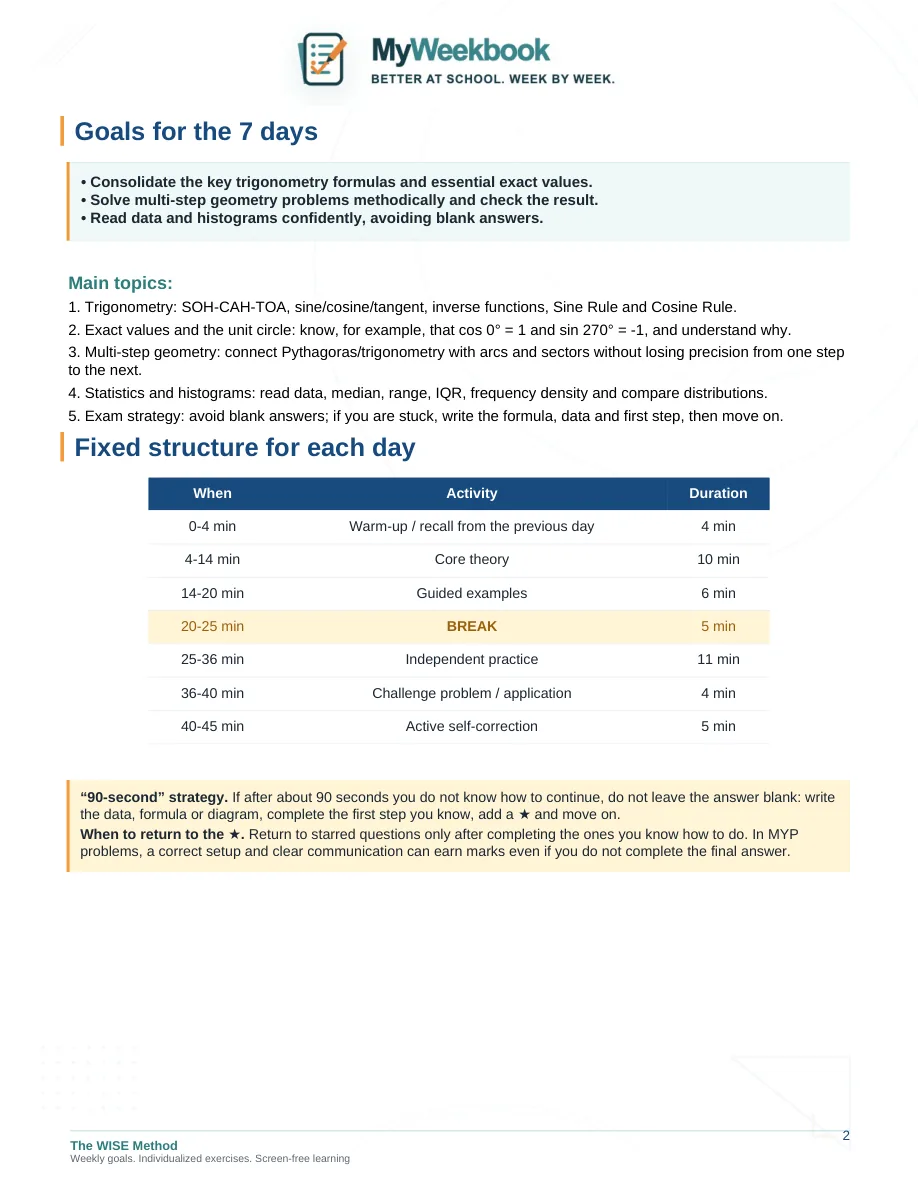
See a sample WeekBook
Explore a seven-day maths example and see how goals, exercises and self-correction fit into a routine.
Open the sample PDFFurther reading
These university resources offer organisational guidance. This guide’s examples are practical adaptations for schoolwork, not a validated protocol or evidence of MyWeekbook’s effectiveness.
- Cornell University — Break the Cycle of Procrastination
Strategies for recognising obstacles and breaking up work.
- Stanford University — Getting Started on Tasks
Guidance on task initiation and choosing a first step.
- Washington University — How to Reduce Procrastination
A guide to reflecting on delays and preparing bounded goals.
Schoolwork and procrastination questions
How do I start studying when I do not feel like it?
Choose a small useful action, prepare materials and make a brief attempt. Decide the next step using what you can actually do.
Does the five-minute rule always work?
No. It bounds the initial attempt rather than guaranteeing success. If stuck, clarify instructions or a missing prerequisite.
Which subject should I start with?
Consider deadlines and difficulty. Choose a priority task and an accessible first step rather than spending all your time on secondary activities.
How can I avoid my phone while studying?
Decide beforehand where to leave it and when to check it. If required for the task, prepare resources and close unnecessary content.
What if I have delayed until the night before?
Check requirements, select priorities and make a realistic plan. If you cannot meet the deadline, discuss the difficulty with the teacher.
Do I have to start over if I miss a day?
No. Restart in the next available slot and review the workload. A missed session is information for adjusting the plan.
How can I tell whether things are improving?
Observe whether you start the planned task, what you produce and which obstacles remain. Include understanding and independence, not just minutes.
Does the plan solve every study difficulty?
No. If the difficulty persists, discuss appropriate support with a teacher or tutor. Organisational strategies do not replace specialist support.