Start with deadlines, materials and real commitments
Before filling your calendar, collect homework, tests, presentations and topics that need another attempt. Check your school planner or learning platform and read the teacher’s instructions. For each task, record its deadline, the materials required and the output: reading a page is different from being able to explain it.
Add fixed commitments: school, travel, sports, lessons and family appointments. Include meals, rest and time to get ready. Do not treat every empty space as study time. A sustainable plan needs to work when you are tired or an assignment takes longer than expected.
Choose priorities without abandoning other subjects
Separate tasks that are due soon, tasks with several stages and skills you cannot yet use independently. A short assignment for tomorrow and a test in five days both matter, but need different preparation. Start complex work early while keeping a defined slot for immediate homework.
Choose one or two priority outcomes for the week. Write “solve equations with brackets and check the answer” rather than “improve maths”. Keep homework and short reviews for other subjects. If deadlines exceed the time available, seek clarification or help before the backlog grows.
How much study time do you need? Start with an estimate
There is no single number of study hours that suits everyone. Age, school demands, prior knowledge and concentration affect the time needed. Break an assignment into observable actions and estimate each: reading instructions, reviewing an example, making a first attempt and correcting it. The first week also helps you learn how long tasks actually take.
After a session, record planned and actual time. If a twenty-minute task took forty, identify the missing step: a concept, finding materials or an exercise that was too difficult. Adjust the next estimate. A useful plan responds to evidence without treating working slowly as a personal failure.
Turn subjects into tasks you can check
“Study history” is hard to start and hard to finish. An actionable task includes a topic, an action and a check: “explain three causes of the event without notes, then compare my answer”. Prepare the book, pages and questions beforehand. At the end, you should be able to say what changed in your understanding.
Combine understanding, an attempt and feedback. In maths, review an example and try a related problem; in science, reconstruct a process and check the steps; in a language, use words in new sentences. Page counts help organise materials, while completing a task reveals what you have learned.
Spread review across several days
Avoid leaving all revision until the night before a test. After the first study session, schedule short attempts on other days. Close your notes, recall an explanation or procedure, then check it. If the attempt is difficult, revisit the missing point and try again. Your calendar should organise opportunities to learn, rather than repeated reading alone.
Review intervals depend on the topic and deadline. For a Friday test, you might work on the topic on Monday, Wednesday and Thursday, using different tasks. This is an example rather than a universal schedule: a missing prerequisite needs attention first. Use your attempts to decide which topics still deserve time.
Example weekly plan: a test and sports commitments
Imagine a maths test on Friday and sports practice on Tuesday and Thursday. The example below spreads preparation while leaving room for other homework. Adapt the tasks to the teacher’s instructions: this table does not represent every school assignment for the week.
On busy days, choose a shorter task with materials already prepared. The day before the test, check recurring errors and organise equipment instead of introducing a whole new chapter. After the test, keep the feedback to guide the following week.
| Day | Priority task | Check |
|---|---|---|
| Monday | Review equations and brackets | Explain an example without notes |
| Tuesday · sports | Brief attempt at two equations | Mark the first uncertain step |
| Wednesday | Word problems with equations | Explain your choice of method |
| Thursday · sports | Review errors and prepare equipment | Try a new exercise |
| Friday | Test and collect feedback | Record questions to clarify |
| Saturday | Flexible slot and other homework | Complete remaining priorities |
| Sunday | Review deadlines and the plan | Choose the next goal |
A 45-minute session: work, a break and self-correction
One possible routine is twenty minutes of work, a five-minute break and another twenty minutes of work. Use the first block to review a key point and attempt guided practice, then move to an independent attempt in the second. Reserve the last five minutes of that second block for correction and a note about what remains difficult.
The forty-five minutes include the break; self-correction does not add a third block. This is one structure for a focused goal, rather than every student’s total daily study requirement. Shorten or adapt it when appropriate, and schedule additional tasks separately if school assignments need more time.
A weekly study plan template to copy
Copy the template onto paper or into your planner. Add fixed commitments first, then deadline-driven tasks and review sessions. Leave a flexible slot for work that moves. Write the check beside each activity: this distinguishes “I spent time on it” from “I can do it”.
A concrete entry might read: “Wednesday, 17:00, maths, solve two percentage problems, check by explaining the method, difficulty with reverse percentages”. The check may show that you need help. Fill in a week you can actually follow rather than an ideal schedule.
| Day and time | Task and materials | Estimated time | Check / next step |
|---|---|---|---|
| Monday · ___ | ___ | ___ | ___ |
| Tuesday · ___ | ___ | ___ | ___ |
| Wednesday · ___ | ___ | ___ | ___ |
| Thursday · ___ | ___ | ___ | ___ |
| Friday · ___ | ___ | ___ | ___ |
| Weekend · ___ | ___ | ___ | ___ |
| Flexible slot · ___ | ___ | ___ | ___ |
How to adapt the plan when sessions are missed
If you miss a session, do not automatically move everything to tomorrow. Check what is still urgent, which task enables later work and what can wait. Use the flexible slot or reduce the number of goals. A smaller set of properly completed tasks tells you more than a long list marked done without evidence.
When several assessments are close together, start preparation earlier and identify conflicts. Keep rest and essential commitments in the schedule. If you repeatedly cannot meet deadlines, review the plan with a teacher, parent or tutor. The workload, approach or support may need to change.
The parent’s role: support planning and build independence
A parent can help gather deadlines and make timings realistic. Ask the student what task they want to complete and how they will check it. Allow them to make decisions: planning is a skill developed through attempts, discussion and small adjustments.
Agree on a short weekly review and a simple way to ask for help. Start with “which step held you up?” and “what should we change?”. Younger students may need fewer tasks and more concrete instructions; more independent students can take greater responsibility for choosing their schedule.
Review the week: check understanding and sustainability
At the end of the week, use a new question or a closed-notes explanation to check your priority goal. Compare it with the first attempt: which steps can you now complete with less help? Record remaining errors and use that evidence for the next plan. A tick on a calendar alone does not measure learning.
Check sustainability too: underestimated tasks, sessions repeatedly missed on the same day, missing materials and insufficient breaks. Change one element at a time so you can see whether it helps. You do not need to redesign the system every weekend; keep what works and adjust the main source of difficulty.
From a calendar to a WeekBook: what to study each day
The calendar tells you when to work; study materials tell you what to work on. When a test or topic reveals a specific difficulty, a WeekBook can support the plan with explanations, examples and targeted exercises. Fit that pathway around assigned homework and check that the workload remains realistic.
The example below shows one way to organise a seven-day pathway. It is a sample; your plan should follow your actual topics and needs. The pathway supports the teacher’s instructions and does not guarantee an academic result. Use practice and self-correction to identify the next step.
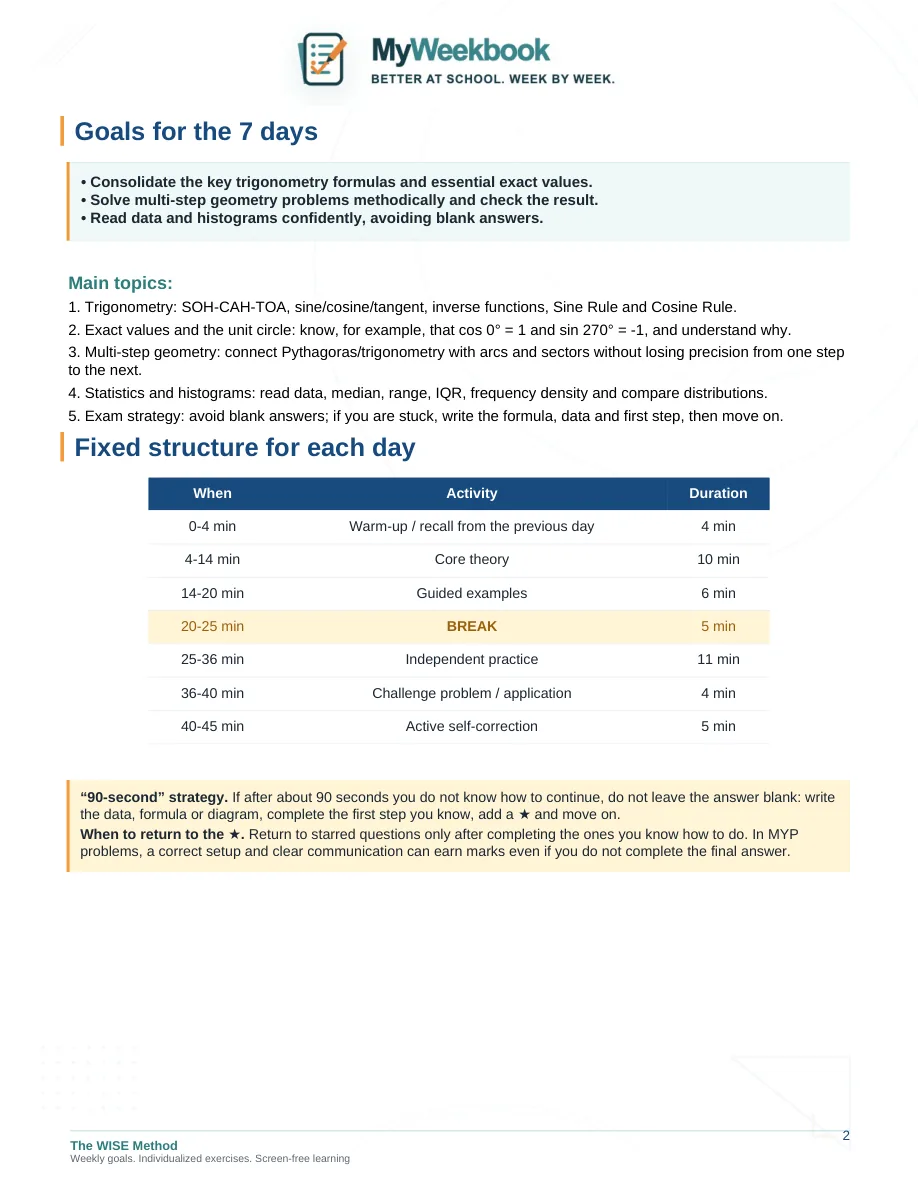
See a sample WeekBook
Explore a seven-day maths example and see how goals, exercises and self-correction fit into a routine.
Open the sample PDFThe evidence behind review activities
These sources concern learning techniques. The weekly schedules in this guide are practical examples, not validated protocols or evidence of the MyWeekbook product’s effectiveness.
- Dunlosky et al. (2013)
Review of evidence on practice testing and distributed practice.
- Institute of Education Sciences (2007)
Guidance on organising learning and checking understanding.
- Karpicke & Blunt (2011)
Research on retrieval practice; it does not test the calendar proposed here.
Weekly study plan questions
When should I prepare my plan?
Choose a regular time, such as Sunday or Monday, and update it when new tasks arrive. Gather enough information to start; you do not need to predict every detail.
How many hours should I study each day?
This depends on school demands and your needs. Estimate concrete tasks and compare actual time. A 45-minute routine is an example for a focused goal, not a prescription for all studying.
Should I study every subject every day?
Allocate subjects according to deadlines and needs. Give priority topics several review opportunities without scheduling a long block for every subject each day.
How do I fit study around sports?
Add practice and travel first. Choose shorter tasks on busy days and prepare materials beforehand. Place demanding work in suitable available slots.
What if I miss a day?
Review priorities and deadlines, use your flexible slot and postpone what can wait. Avoid automatically doubling the next day’s workload.
Should I use paper or a digital planner?
Choose a format you will actually consult. Both can work if the plan is readable, easy to update and includes concrete tasks and checks.
Can younger secondary students use this plan?
Yes, with appropriate task length, complexity and support. A younger student may need fewer tasks and an adult’s help interpreting assignments.
How do I know the plan is working?
Check whether you complete tasks, explain topics and answer new questions with less help. Also check whether the schedule remains sustainable.
How can I fit in a WeekBook?
Schedule its activities alongside school assignments in available slots. Use it for a specific difficulty and let self-correction guide later sessions.