What to do first after a disappointing test
When you receive a test with a disappointing result, keep the full paper and your teacher’s comments. Choose a time when you can review it calmly before adding more study tasks. Your first job is to understand what each question asked and where your attempt stopped working.
Gather the paper, your notes on the topic and one or two examples from class. If the test is unavailable, ask your teacher how to review it or obtain the material you need for studying. If you have only the result, record what you remember about the questions and request specific feedback on the points to revisit.
Clarify whether there will be another test, a spoken assessment or a recovery task, and which topics it will cover. These details give your work a deadline and scope. The seven-day plan here is a study cycle for a particular difficulty; any formal reassessment follows your school’s instructions.
Gather evidence
The completed paper, feedback, instructions and class material.
Clarify the next assessment
Ask about topics, format and timing if a reassessment is planned.
Choose a starting point
Select a question you can analyse and turn into a concrete learning goal.
How to read a marked test and your teacher’s feedback
For each question, read the instruction before your answer. Find the verb describing the task: calculate, compare, explain, justify or prove. A response can include correct information and still be incomplete when it does not perform the requested task. Note units, constraints and any request to show reasoning.
Compare your attempt with the teacher’s comments and the expected method. Find the earliest step that needs correcting, rather than looking only at the final answer. In a problem, an early error can affect later work; in an extended response, a connection or example may be missing from the explanation.
Write a specific question when the feedback remains unclear: “Am I missing a step here, or have I chosen an unsuitable formula?” or “Which part of the instruction have I not developed?”. For partly correct responses, keep what works and identify what needs completing. Successful attempts also show skills you can use when restarting.
Classify the mistakes: which practice do you need?
Identify the difficulty from your attempt and the feedback. The same wrong answer can have different causes. If you do not recognise when a formula applies, practise explanation and a reasoned choice. If the formula is suitable but a sign changes during calculation, focus the work on that step.
Treat the categories as possibilities to check. Attempt a short question about the uncertain point and observe whether you can complete it independently. Before attributing an error to distraction, check your understanding of the concept and method. When an instruction remains ambiguous, discuss it with the person who set the task.
| Mistake | What to look for | Next activity |
|---|---|---|
| Concept understanding | A definition, relationship or rule you do not understand | A short explanation, example and question in your own words |
| Choice of method | A formula or strategy that does not fit the situation | Compare examples and explain which method applies |
| Execution | An incorrect sign, calculation, unit or copied step | Practise that step and use a specific check |
| Reading the instruction | Ignored information or a request left unanswered | Restate the question and list its requirements |
| Incomplete response | An unfinished method or undeveloped explanation | Outline the answer and make a complete attempt |
Identify learning gaps and choose a recovery priority
Group errors that appear to come from the same skill. If several problems stop when you work with fractions, make a short attempt on that prerequisite. If you can calculate but cannot select the right relationship, start with recognising the problem type. Confirm your priority through an attempt.
Choose a small, observable goal. “Catch up on all of maths” does not describe the week’s activity. You could write: “identify the hypotenuse, apply Pythagoras and check the answer in a right-angled triangle”. In history, the goal might be explaining an event through its causes, consequences and a relevant example.
Decide on a final question before starting the plan. It should require the same skill as the initial attempt, with different numbers or wording. If many prerequisites are missing, organise further cycles of work and discuss the order with your teacher or tutor. Keep the week manageable alongside your other homework.
- The goal comes from an observable mistake in the test.
- You can describe what you should be able to do independently.
- You have material to revisit the explanation.
- You have selected an unfamiliar question for the final check.
Correct mistakes actively and make a fresh attempt
Active self-correction makes the cause of a mistake visible and prepares another attempt. Use a different-coloured pen and keep your original response. Mark the first line to correct, state what should change and explain why. Then cover the solution and reconstruct the method.
For example, a right-angled triangle has legs of 6 and 8 cm. If you added the lengths and answered 14 cm, revisit the relationship between the squares: c² = 6² + 8² = 100, so c = 10 cm. Write why Pythagoras applies and which side you are finding. Check that the hypotenuse is longer than either leg.
Change the numbers for your next attempt: with legs of 5 and 12 cm, the hypotenuse is 13 cm. Then try a question where a leg is unknown. If this variation stops you, revisit the meaning of the formula and the choice of sides. A correct final answer becomes more informative when you can explain the steps.
Describe
What you did and which step needs changing.
Explain
The rule, information or connection that justifies the correction.
Redo
The method without keeping the solution in front of you.
Vary and revisit
A different question on the same goal, followed by a return on another day.
A seven-day recovery plan for one specific goal
The plan below is a proposal to adapt to your learning gap and available time. Dedicate a daily block to the selected goal and keep examples, attempts and corrections in the same notebook. Each day revisits part of the earlier work and adds a manageable task.
Prepare a brief starting check and a final check of similar difficulty, using different questions. Compare understanding, choice of method and the help needed. If your deadline is sooner, select fewer essential activities. If difficulties are extensive, discuss a longer pathway. Seven days provide a cycle of work without a promise to close every gap.
| Day | What to do | What to keep |
|---|---|---|
| 1 | Analyse a question, check the prerequisite and define the goal | Initial attempt and priority gap |
| 2 | Revisit the explanation and complete worked examples | Steps explained in your own words |
| 3 | Recall the rule and attempt questions with less help | Independent attempts and uncertain points |
| 4 | Correct the recurring error and change the data or question | A fresh attempt and its correction |
| 5 | Alternate familiar question types and choose the method | The reasoning behind your choices |
| 6 | Try a short practice assessment in the expected format | Complete responses and remaining difficulties |
| 7 | Complete a comparable final check and select the next step | Starting/final comparison and next goal |
How to use the 45-minute daily session
The WISE Method proposes 20 minutes of work, a 5-minute break and another 20 minutes of work. The final 5 minutes of the second block are for self-correction. The session lasts 45 minutes in total: 40 minutes of activity and a 5-minute break. This block addresses your selected goal and can sit alongside other schoolwork.
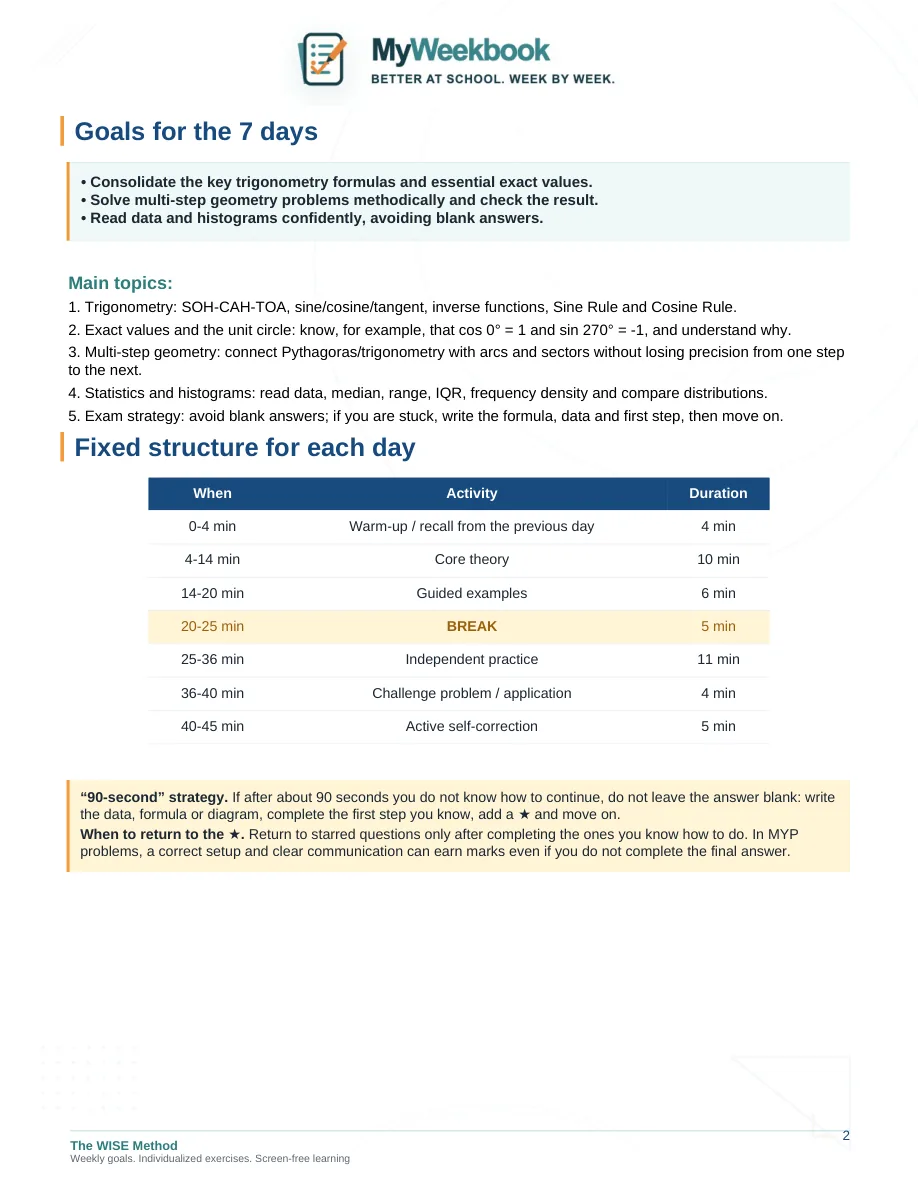
In the first block, recall a point from the previous day and revisit the explanation you need. After the break, attempt questions independently and check the work. The mathematics example separates theory, examples and practice as shown below. Use the structure as a reference and adapt the activities to the subject.
Prepare the printed WeekBook, paper, pen and necessary tools before starting. During the MyWeekbook session, phones, tablets and computers stay out of reach. If an exercise needs a calculator, follow the material and your school’s instructions. The break gives you a pause from the task before returning to the point marked on your page.
| Minutes | Activity | Purpose |
|---|---|---|
| 0–4 | Recall · 4 min | Revisit a rule or step |
| 4–14 | Explanation · 10 min | Clarify the selected difficulty |
| 14–20 | Examples · 6 min | Understand the procedure |
| 20–25 | Break · 5 min | Pause the work |
| 25–36 | Practice · 11 min | Attempt with less help |
| 36–40 | Application · 4 min | Choose and use the method |
| 40–45 | Self-correction · 5 min | Check and record the mistake |
Recovery practice for maths, languages and essay subjects
The work should address the difficulty revealed by the test and the response format required. Choose examples from class and vary the question after correction. For each subject, keep the first attempt and an explanation of what you changed.
Maths and physics: separate selection, calculation and checking
Write the known information and unknown, choose the relationship and explain why it applies. Complete the steps with visible units and signs, then check the result. If you lose precision in multi-step problems, record intermediate results and leave rounding until the end when the procedure requires it. If choosing the formula is the difficulty, compare different questions before adding calculations.
History, literature and science: reconstruct a complete response
Revisit what the question asked you to explain. Make an outline with a central idea, connection and relevant example. In history, distinguish causes and consequences. In literature, use a passage to support the interpretation. In science, describe the stages of a process. Write or present the response without reading the whole outline, then check the missing points.
Languages: move from an individual error to a sentence and text
Group similar errors, such as a verb structure or vocabulary used out of context. Review a correct example, try some sentences and use the structure in a short text. For comprehension, identify the passage supporting your answer. If understanding the instruction or reading the text is the difficulty, address that part before increasing the number of questions.
Prepare for your next test or spoken assessment
Use your teacher’s instructions to select a short practice assessment covering the topics and format of the next task. For written work, prepare clear, complete responses. For a spoken assessment, explain a concept, its connection and an example aloud, without reading a whole page.
If timing was an observed difficulty, try a realistic time limit and check where you use the time. Break longer instructions into smaller requests. When you get stuck, write the step you know and mark the question to revisit. Compare your response with class material and find the point that needs clarification.
Before the assessment, make a short list of remaining uncertainties. Revisit those steps and try again, keeping a clear priority for any extra material. Prepare the tools allowed and check that you know what the question requires. The practice assessment guides your final preparation; your teacher determines the evaluation of the new attempt.
- Topics and assessment format clarified.
- Unfamiliar questions attempted without solutions.
- Corrections explained and tried again.
- Necessary materials and tools ready.
How to help your child after a disappointing test
Begin with a short conversation about the task: which question was difficult, what did they understand from the feedback and which point needs clarification? Look at an actual attempt together. Let your child explain the choice, even when the result is incorrect. This helps frame a question for the teacher or tutor.
You can help gather documents, find a realistic study time and divide the work into manageable activities. During practice, leave room for an independent attempt. If an explanation is needed, focus on the missing step and then offer a question they can complete alone. At the end, look at a correction and define the next task.
If difficulties recur across many tests or the student cannot understand the corrections, share examples and attempts with the person supporting them. A tutor can help establish priorities and adapt practice; the teacher clarifies the course requirements. Keeping the completed work makes these conversations more specific.
How to check whether a learning gap has improved
Try an unfamiliar question that requires the same skill as the initial attempt, at a similar difficulty. Keep the tools and type of support comparable. If one check is independent and the other is guided, account for that difference when comparing them. Look at the method and explanation as well as the result.
Repeating a recently corrected problem practises the step. To check transfer, change the data, context or wording. If you succeed, revisit the point on another day. If the same mistake returns, narrow the goal or work on the prerequisite. Partial progress may show which intermediate activity you need before the next assessment.
At the end of the week, write a short summary: what you can complete independently, what still needs a prompt and what you will address next. This helps you choose the next study cycle. Any school outcome also depends on the requirements of the new assessment and is determined by the teacher.
| Aspect | Evidence to look for |
|---|---|
| Understanding | You explain the concept and when it applies |
| Choice of method | You justify the procedure before completing it |
| Independence | You complete the question with fewer prompts |
| Checking | You recognise a mistake and can correct it |
| New application | You use the skill in a different question |
Turn your marked test into a personalised WeekBook
You can build a plan with school material or request a structured pathway from MyWeekbook. Upload a readable marked test with all the instructions and teacher comments. You can add a related assignment or syllabus, up to five documents. Include the school year, subject, language and difficulty you have observed.
A tutor reviews the material and validates a personalised PDF with explanations, worked examples and progressive exercises. Download the WeekBook from the family area and print it. The student works on paper for seven days using the 45-minute routine and records corrections. The mathematics example shows the structure; the personal pathway uses the individual student’s documents.
The first WeekBook is free, with no credit card required. After completing it, you can decide how to continue. Optional services also include WISE Progress, with a review of the completed work, live feedback and another WeekBook. The offer page explains the services and terms. MyWeekbook supports practice and study organisation for students aged 11–18.
Explore an example before you start
The mathematics WeekBook shows goals, explanations, examples, independent practice and self-correction across seven days. It demonstrates the format; your own WeekBook is built around the test and difficulty you upload.
Open the example WeekBook in English (PDF)Sources and principles behind the plan
These references support retrieval, distributed practice and alternating examples with attempts. The recovery plan, 20 + 5 + 20 structure and examples in this guide are MyWeekbook practical proposals. The references do not validate guaranteed recovery in seven days or the service as a whole.
- Dunlosky et al. (2013)
The learning-techniques review is a reference for retrieval practice and spreading study over time.
- Institute of Education Sciences (2007)
The guide recommends, among other activities, alternating worked solutions with independent problems, retrieval questions and explanations of concepts.
- Karpicke & Blunt (2011)
The study of retrieval with science material informs the use of reconstructing an answer from memory and then checking it.
Frequently asked questions about recovering from a test
How do I recover from a bad test?
Review the instructions and feedback, find the first error and choose a priority gap. Alternate explanation, independent practice and self-correction. Check the goal with unfamiliar questions and ask your teacher about any formal reassessment.
Should I revise the whole syllabus?
The test can help define your priority. Check which skills are secure and which prerequisites are missing. Revisit what is needed for the goal and use your teacher’s stated syllabus to organise preparation for the next assessment.
Can I catch up in one week?
A week can provide an initial cycle for a manageable difficulty. Extensive gaps and several missing prerequisites may need more time. The plan does not guarantee a particular school outcome. Look at the completed work and clarify assessment deadlines with your teacher.
What if I studied but the test still went badly?
Compare your preparation with the tasks in the test. If you mainly read, try answering without notes. If you repeated identical examples, vary the questions. If you know the content but your answers are incomplete, practise the response format required by the instruction.
How can I distinguish a learning gap from a calculation mistake?
Find the first incorrect step and try a brief targeted question. If you can explain and select the method but perform an operation incorrectly, work on that step. If you do not know when the rule applies, revisit the concept or prerequisite with teacher support when needed.
Does the 45-minute session include the break and self-correction?
Yes. It includes 20 minutes of work, a 5-minute break and another 20 minutes of work. The final 5 minutes of the second block are for self-correction: 40 minutes of activity and a 5-minute break, or 45 minutes in total.
What can I do without the marked test?
Ask your teacher how to review the paper and obtain useful feedback. You can start with a related assignment or syllabus and record the difficulty observed. For a WeekBook, upload a readable school document and describe the point you want to address.
How can I help my child without completing the questions for them?
Help gather material and choose a realistic study time. Ask them to explain an attempt and a correction while leaving room for independent work. If a step remains unclear, frame a specific question for the teacher or tutor together.
Is the first WeekBook free?
Yes. The first WeekBook is free and does not require a credit card. It is a personalised printable PDF based on uploaded school material. After the trial, the family chooses whether to use further options described on the terms page.