Where to start if you do not have a study method
High school brings more subjects, deadlines and responsibility for your own work. A method that helped in earlier school years may need adapting. Choose one subject and gather a marked test, a recent assignment and your teacher’s instructions. These show the tasks you are expected to complete.
Try a short question without your textbook. Notice where you stop: do you misunderstand the instruction, forget the concept, struggle to choose a method or lose track of a step? This starting attempt helps you select useful practice. “Study maths” is too broad; “recognise when to use Pythagoras and check my answer” gives you a goal you can work on.
| What happens | What to try | Where to start |
|---|---|---|
| The page looks familiar, but you cannot explain it | Answer three questions with the book closed | Active recall and checking your answers |
| You follow the example but get stuck on your own | Try a similar problem with different numbers | A worked example, then independent practice |
| The same mistake keeps returning | Find the first line where your reasoning goes wrong | An error log and a fresh attempt |
| You struggle to finish before the deadline | List tasks, deadlines and available study time | Priorities and smaller tasks |
A high school study method in five steps
Use this sequence for a manageable topic. The activities vary between subjects, but each session should include time to understand, attempt and check. Start with your school material and compare your answers with a reliable reference.
Define the outcome
Write what you want to be able to do: explain the causes of an event, solve a problem or use a language structure. Add a sample question that will help you check it.
Understand one piece at a time
Read a short section, clarify terms and connect the idea to an example. For a procedure, identify why each step in the worked solution is needed.
Recall without looking
Close your notes and reconstruct the content in your own words. Write an answer, explain a formula or give a short spoken explanation. Then check what you missed.
Apply it independently
Attempt a question that differs from the example. Keep your attempt on the page before reading the solution: it shows your reasoning and the point you need to revisit.
Correct and plan a return
Check the answer, explain your mistake and prepare a question to try on a later day. Correction means being able to complete the step again, rather than simply copying the right answer.
Study techniques: active recall, spaced practice and worked examples
Each technique has a purpose. Active recall and distributed practice have support from learning research; summaries, concept maps and examples can complement them when you use the material to answer questions and reason. Adapt your choice to the topic and your existing knowledge. References are listed in the sources section.
References: Dunlosky et al., IES and Karpicke & Blunt
Active recall: try answering before reopening your notes
Active recall means retrieving information from memory. After a short reading, close your notes and answer a question. If the answer is incomplete, compare it with the material and correct it. This is practice that reveals what needs another look.
In history, explain the relationship between two events. In science, reconstruct the stages of a process and describe what happens at each stage. In maths, write a formula, explain when it applies and attempt a problem. Prepare questions that ask “how” and “why”, as well as questions about facts.
Spaced practice: revisit the content on different days
Distributed or spaced practice separates study opportunities over time. You could return to a topic the following day, later in the week and in your final check. This is one possible schedule, not a universal interval: revisit sooner when you struggle and gradually leave a longer gap when your answers are secure.
Begin a review with a question without notes. Use your answer to decide what needs another explanation or attempt. Leave room in your weekly plan for both new work and brief returns to earlier content.
Worked examples and independent practice: make the steps visible
A worked example can help when you are missing a procedure. Cover the next line and try to predict it; then check and explain the choice. Attempt a similar question without the solution in front of you. Once the basics are more secure, mix familiar question types and choose the strategy yourself: deciding which method to use becomes part of the task.
Concept maps and summaries: organise them around a question
A concept map can show relationships, while a summary can help select the main ideas. Start with a question, use your own words and keep the detail relevant to the answer. Then reconstruct the outline without looking. If copying or colouring takes up your whole session, reserve a block for explanation and practice.
A 45-minute study session: 20 + 5 + 20
The MyWeekbook WISE Method proposes a routine for one specific difficulty: 20 minutes of activity, a 5-minute break and another 20 minutes of activity. The break is included in the 45 minutes. The final 5 minutes of the second block are for active self-correction and a review of the session.
This structure is also used in the sample mathematics WeekBook. It does not define the total study time you need each day: homework, the number of subjects and your starting difficulties may require further sessions. Prepare the material and goal before starting so that searching for notes does not take over the block.
| Minutes | Activity | What to do |
|---|---|---|
| 0–4 | Warm-up · 4 min | Recall a concept or step from the previous day |
| 4–14 | Explanation · 10 min | Understand the point needed for your goal |
| 14–20 | Worked examples · 6 min | Follow the method and explain the choices |
| 20–25 | Break · 5 min | Stand up, have a drink and leave the work aside |
| 25–36 | Independent practice · 11 min | Attempt questions without copying the example |
| 36–40 | Application · 4 min | Try a question that requires choosing a method |
| 40–45 | Self-correction · 5 min | Check, record the mistake and prepare the next step |
How to organise studying with a seven-day plan
Write down the week’s deadlines and identify the topics that need more work. Give each session a concrete task and a completion criterion. If you have sport or other commitments, choose a realistic time and leave some room for unexpected homework.
The plan below is a proposal for one difficulty. You can dedicate a 45-minute block to that goal and organise other subjects separately. Keep your initial attempts: compare the reasoning with your final work, using unfamiliar questions of similar difficulty.
| Day | Session goal | Evidence to keep |
|---|---|---|
| 1 | Initial attempt, selecting the difficulty and a first worked example | Your starting attempt and written goal |
| 2 | Recall from day one and practice on the missing step | Answers and first corrections |
| 3 | Brief review and an application with different data or questions | The method explained in your own words |
| 4 | Revisit the recurring mistake and practise with less help | An independent attempt |
| 5 | Different question types linked to the same goal | Your reason for choosing a strategy |
| 6 | A short practice test or spoken explanation | Complete answers and remaining uncertainties |
| 7 | A comparable final check and your next learning goal | Starting/final comparison and next step |
How to adapt the method for maths, languages and essay subjects
Your study method should practise what the subject requires. Recalling a definition and solving a problem are different tasks; preparing a spoken answer also requires explaining a connection. Choose your practice by looking at the assignments and questions your teacher sets.
Maths and physics: choose a method and check the result
Before calculating, write the known values, the unknown and the relationship you will use. Explain why it applies, complete the steps and check units and plausibility. If the formula is right but your signs are wrong, practise that particular step. Once you can answer one type of question, alternate it with other familiar types to practise choosing the method.
For a right-angled triangle with legs of 6 and 8 cm, the hypotenuse is √(6² + 8²) = 10 cm. The check is part of the answer: the hypotenuse must be longer than either leg. On the following day, change the numbers or consider how to find a leg when the hypotenuse is known.
History, literature and philosophy: connect and explain
Turn headings and paragraphs into questions. In history, distinguish causes, events and consequences. In literature, connect an idea to a passage. In philosophy, reconstruct a claim and the reasoning that supports it. Prepare a short outline, then explain without reading. Check whether you have supplied an example and whether the connection fits the material.
Science: move between words, diagrams and explanations
Draw a simple process and describe what happens at each stage. Reconstruct the diagram from memory and compare it with your textbook. Add an application question: what would change if one stage were missing? When learning a term, write its meaning and use it in a sentence about the topic.
Languages: use vocabulary and structures in context
Recall a word, use it in a sentence and check the form and meaning. For grammar, complete a targeted exercise and then write a short text using the structure. For comprehension, answer the question and identify the passage that supports your answer. If reading is demanding, select a short text at a suitable level before increasing its length.
How to prepare for tests and spoken assessments
Start with the syllabus, instructions and criteria provided by your teacher. Prepare questions that reflect the tasks you will be assessed on, including the points you have found difficult. A practice assessment helps identify where you get stuck before the real one; use a time limit when it is relevant to the assessment.
Define the scope
List topics and question types. Mark those you can answer independently and those where you still need an example or explanation.
Practise the response format
For a written test, produce readable steps and complete answers. For a spoken assessment, practise an explanation with an opening, development and example, without reading the whole outline.
Try a short practice assessment
Choose unfamiliar questions, work without solutions and use the tools allowed at school. For longer tasks, write the known information and a plan for your reasoning first.
Use correction to guide your final review
Compare your response with notes, criteria or a solution and revisit missing steps. Before the deadline, focus your final review on uncertainties from the practice attempt and prepare the materials you will need.
After a disappointing test: use mistakes to improve your study method
A marked test shows where your method needs adjusting. Read the question and feedback first, then find the earliest part of the response that does not work. Distinguish a misunderstood concept from an unsuitable method, an execution error or an incomplete answer. Each calls for a different next activity.
Make a small paper error log with four columns: question, mistake, explanation and new attempt. Write a specific sentence, such as “I chose the wrong side as the hypotenuse”. Add a question where you must identify the sides before calculating, and try it again on a later day.
If several errors come from the same missing prerequisite, address that first. When you cannot explain a correction, ask your teacher or tutor to clarify it. Choose your next step from what you have observed, using a goal small enough to check.
Concentration and getting stuck: prepare a manageable session
Before starting, put only the materials needed for the task on your desk. In the MyWeekbook routine, you use a printed WeekBook, paper and pen; phones, tablets and computers stay out of reach during the session. This sets a clear study period before you return to your devices.
If you often delay starting, make the first activity concrete: read the instruction and write the known values, or answer the first question. If the same point stops you each time, change the activity or ask for an explanation of that step. Your error log helps you ask a specific question.
- Decide what needs completing during the block before you start.
- Have your notes, WeekBook and necessary tools ready.
- Take the planned break and return to the task marked on the page.
- At the end, record what is clearer and which question remains open.
How parents and tutors can help without doing the work
Parents can help protect a realistic study time, gather materials and keep the plan manageable. During practice, give the student time to make an attempt. Ask “what are you trying to find?” or “why did you choose that step?” and observe whether they can explain the answer.
At the end, look at a question and a correction together. Discuss what has become clearer and what is needed for the next session. A brief, specific conversation gives you more useful information than checking only how many hours were spent at a desk.
Before the session
Check the goal, materials and available time. Let the student write down the day’s task.
During the session
Encourage a visible attempt. If help is needed, focus the explanation on the missing step, then offer a question the student can try independently.
After the session
Look at the error log and choose the next step. Share specific questions with the teacher or tutor when corrections remain unclear.
How to check whether your study method is working
Compare an initial attempt with an unfamiliar question of the same type and similar difficulty. Look for changes you can observe in the reasoning. Repeating the exact question you have just corrected can be useful practice; for the final check, change the question so you can see whether you can choose and apply the method.
If progress appears only with many prompts, prepare an intermediate task with less help. If the same error remains in the final check, narrow the goal or return to the prerequisite. A week is a cycle of practice and review: building habits and closing wider learning gaps may take longer.
- Can you explain the concept in your own words with a relevant example?
- Can you choose the method without a solution in front of you?
- Can you recognise and correct the mistake that used to recur?
- Can you complete an unfamiliar question with fewer prompts?
- Can you identify your next learning goal?
From school material to a personalised WeekBook
You can use this guide to organise studying with your school material. If you need a structured plan for a particular difficulty, MyWeekbook starts from a marked test, an assignment or a syllabus. Include the school year, subject, language and point you want to address. Readable documents and complete instructions help define the work.
A tutor reviews the material and validates a personalised PDF with explanations, examples and progressive practice. Download and print the WeekBook: the student works on paper for seven days using the 45-minute routine and self-correction. The mathematics example shows the format; a personal plan is built around the student’s documents.
The first WeekBook is free, with no credit card required. After the trial, the family can choose how to continue. The service supports school learning for students aged 11–18. The week’s goal and the progress made depend on the starting point and the work completed.
Gather
A marked test or another readable school document, including the instructions.
Request
A WeekBook for the subject and difficulty you want to address.
Print and practise
Follow the explanations, exercises and self-correction across the week.
Review
Use the completed work to choose your next learning goal.
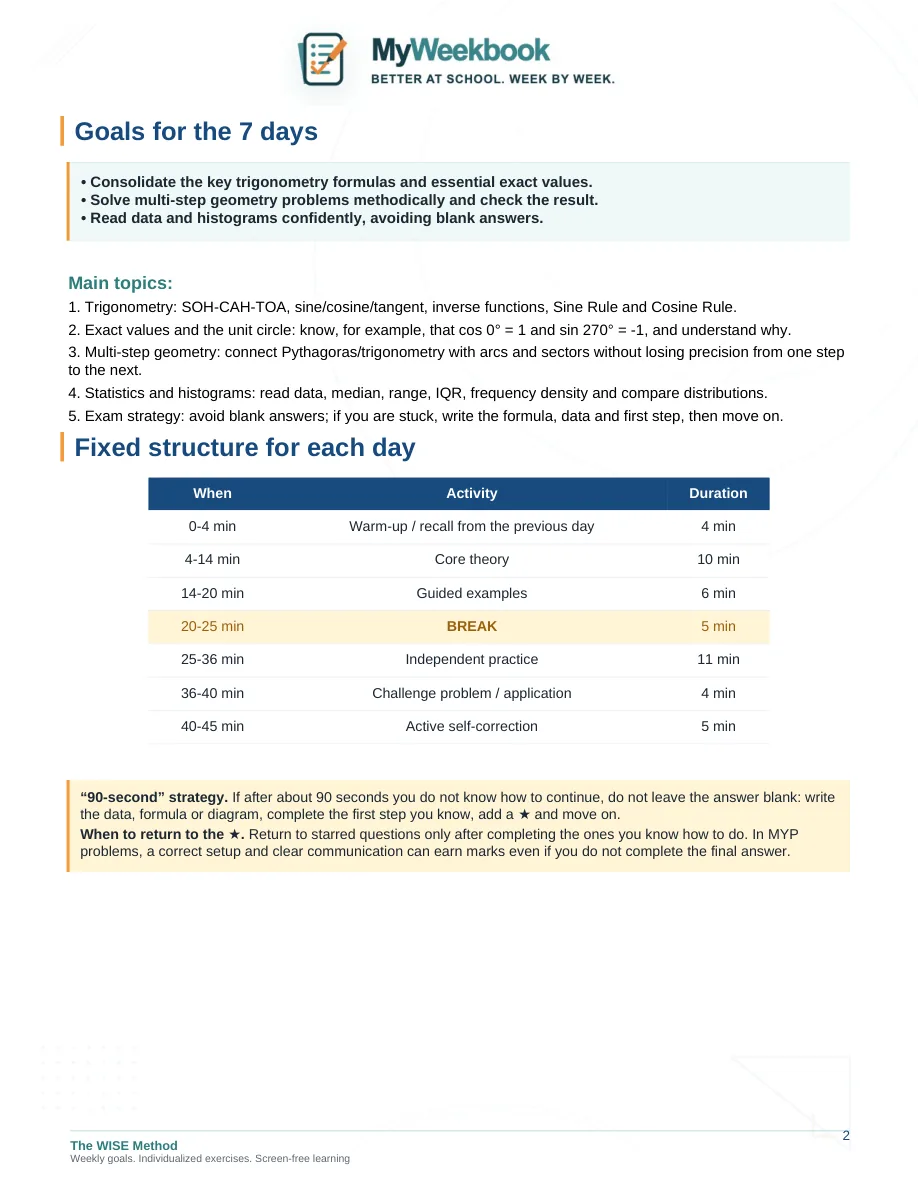
See a week of practice on paper
The mathematics example includes trigonometry, geometry, statistics and histograms, with explanations, activities and self-correction. Open it without registering to see how a WeekBook is organised.
Open the example WeekBook in English (PDF)Sources and how to use this guide
These references support the learning principles discussed here. The seven-day plan and 20 + 5 + 20 structure are MyWeekbook practical proposals: the studies do not specifically validate the service or the length of a session.
- Dunlosky et al. (2013)
This review compares ten learning techniques and rates practice testing and distributed practice as high-utility techniques. It informs the choice of these two principles.
- Institute of Education Sciences (2007)
The guide includes recommendations on spacing, alternating worked examples with independent problems, retrieval questions and explanations of concepts.
- Karpicke & Blunt (2011)
This study examines retrieval practice with science materials. It provides a reference for using questions and reconstruction from memory, within the limits of its experimental setting.
Frequently asked questions about studying in high school
What is the best study method for high school?
A useful method helps you understand, recall without notes, apply and correct. Active recall and spaced practice can be starting points; exercises, spoken explanations and concept maps should fit the subject. Check the method with unfamiliar questions and notice where you still need help.
How do I start if I have never had a study method?
Choose one subject, gather a test or assignment and attempt a question without a solution in front of you. Identify where you get stuck, write a small goal and alternate explanation, independent attempts and correction. The guide’s seven-day plan is an example you can adapt.
How long should a high school student study each day?
The time depends on subjects, homework, deadlines and starting knowledge. Plan concrete tasks and check what you can complete independently. The 45-minute routine is for a manageable learning goal and can sit alongside other schoolwork.
Does the 45-minute routine include the break?
Yes. The WISE routine includes 20 minutes of work, a 5-minute break and another 20 minutes of work. The final 5 minutes of the second block are for self-correction. That is 40 minutes of activity and a 5-minute break, or 45 minutes in total.
Do I need a concept map for every topic?
Use a map when it helps you see relationships or organise an explanation. Learning a procedure also needs practice; preparing a spoken assessment needs speaking practice. After making a map, try reconstructing it and answering questions without looking.
How can I revise when a test is very soon?
Check the required topics, try a short assessment without notes and choose the main uncertainties. Alternate a targeted explanation with a fresh attempt. When time is limited, reduce the number of goals and use your corrections to decide the final review.
Can this method be used in different school curricula?
The sequence can be adapted to different secondary-school programmes. Materials, questions and response formats vary. Use your class syllabus and teacher’s instructions to choose examples and practice appropriate to your course.
How soon will I see progress?
A week can provide an initial comparison for a small goal. Building habits and closing wider gaps takes different amounts of time. Look at independence, understanding and responses to unfamiliar questions. The plan does not promise a particular school result.
Does a WeekBook replace tutoring or a teacher?
A WeekBook supports practice and study organisation. It can complement schoolwork and tutoring. If a concept remains unclear or difficulties are extensive, share attempts and mistakes with the person supporting the student to decide what help is needed next.